25 October 2026 · Translating…
We Were Making Money. So Why Did We Have to Kill Half Our Products?
Design Thinking helps us understand problems and explore solutions. The Product Development Lifecycle helps us build and improve products. But neither replaces the need to manage the Product Lifecycle. So why do we often focus more on building what’s next than keeping what we have healthy?
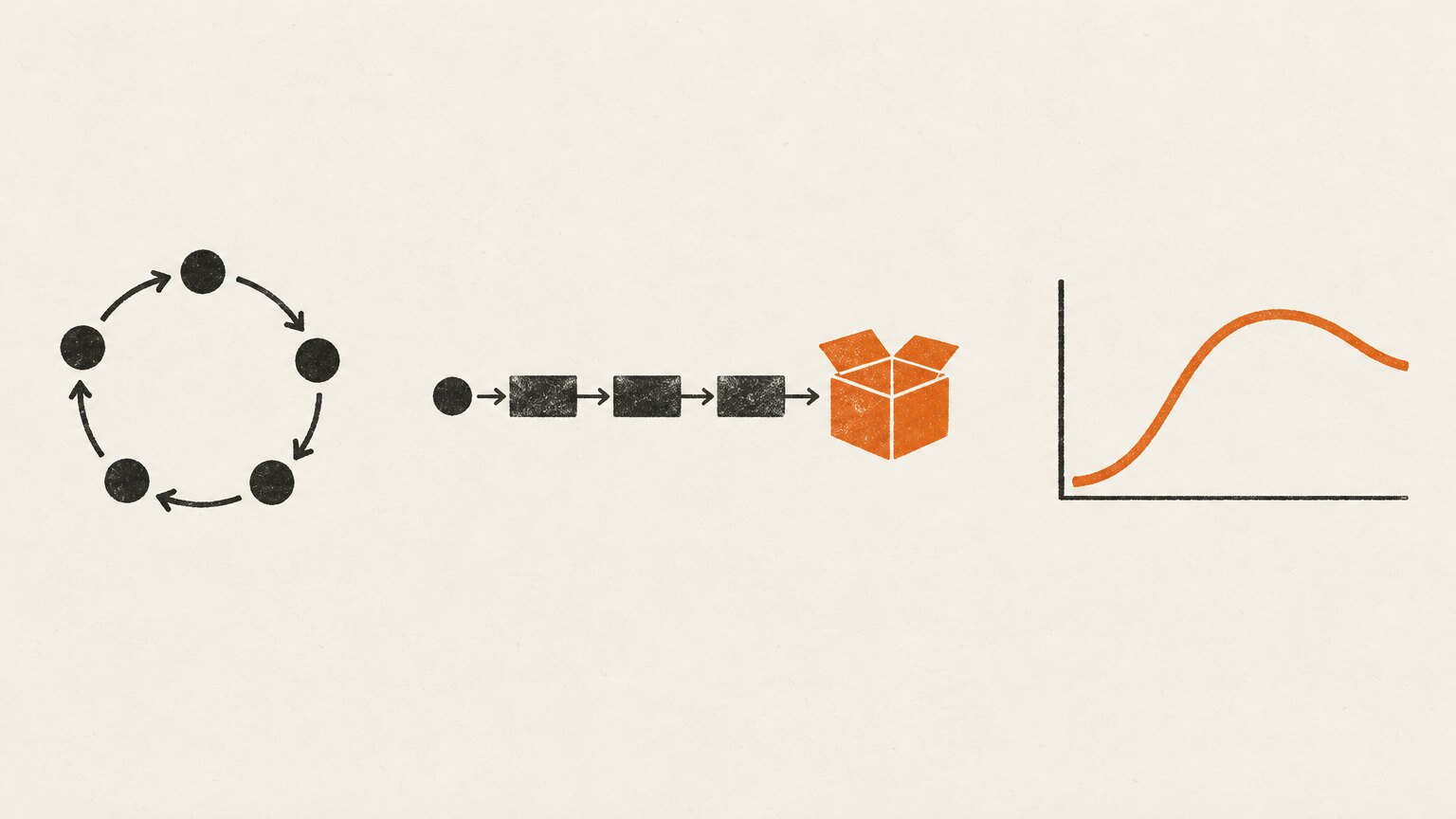
Design Thinking is not the Product Lifecycle. And the Product Development Lifecycle is not the Product Lifecycle either.
These three concepts are connected, but they answer different questions. Understanding the difference matters because, in product management, we can become so focused on discovering problems, designing solutions and launching new features that we forget to manage the life of the products we already have.
I love building digital products. There is something exciting about discovering a customer problem, figuring out how to solve it, designing the experience, bringing the solution to life, finding an innovative go-to-market approach and then watching adoption grow, even if slowly. It gives me goosebumps. I believe many product people feel the same way.
But that excitement can become a distraction if we focus too much on building and not enough on what happens after launch.
Design Thinking: Are we solving the right problem?
Design Thinking is a human-centred approach to problem-solving. It encourages us to understand people, explore their needs, challenge our assumptions and experiment with possible solutions before committing too much time and money to building something.
A common way to describe it is through five activities: empathise, define, ideate, prototype and test. These are useful ways to structure the work, although real product development is rarely a perfectly linear process. We may return to earlier activities as new information emerges.
The value of Design Thinking is that it helps us avoid falling in love with a solution before we properly understand the problem.
A customer asks for a new feature. We could immediately add it to the roadmap. But what if the real problem is that an existing feature is difficult to use? What if customers do not understand how the product works? Or what if the problem has nothing to do with functionality at all?
Without understanding the underlying need, we risk building something that looks innovative but does little to improve the customer experience.
Design Thinking helps us ask better questions, test assumptions and learn from customers. It can help us discover opportunities for a new product, improve an existing service or identify reasons why customers are struggling with something we already offer.
But it does not tell us everything we need to know about managing a product over time.
We can understand our customers, design a good solution and successfully launch it, yet still have a product that struggles with reliability, adoption, retention, commercial sustainability or changing market conditions.
Design Thinking helps us understand the problem and explore possible solutions. It does not replace the ongoing responsibility of managing the product.
The Product Development Lifecycle: How do we turn learning into value?
The Product Development Lifecycle (PDLC) focuses on the process of moving from an opportunity or problem towards a solution that can be delivered, tested and improved.
Depending on the organisation and its methodology, this process may include discovery, definition, design, development, testing, launch, measurement and iteration.
Design Thinking can be used within this process, particularly during discovery and problem definition, but it can also influence design, prototyping, testing and subsequent improvements. It is an approach that can inform the work, not necessarily a separate stage that we complete once and never revisit.
The PDLC is also not limited to creating brand-new products.
We can use it to improve an existing customer journey, fix a recurring problem, optimise performance, simplify a service, test a new pricing model or remove functionality that creates unnecessary complexity.
And sometimes, the process leads us to conclude that we should not build anything at all.
That is an important point. A product development process should not exist simply to turn ideas into features. It should help us make better decisions about where to invest our time and resources.
If customer research shows that a proposed feature will not solve a meaningful problem, we should be able to stop. If data shows that customers are struggling with an existing experience, we may need to fix it before investing in something new.
The goal is not to maximise the number of features delivered. It is to deliver meaningful customer and business value.
Yet this is where product teams can get carried away. We become good at running discovery, managing backlogs, delivering features and organising launches. We have roadmaps to execute and targets to achieve. There is always another opportunity to explore.
We can become very effective at developing products while paying too little attention to whether those products remain healthy.
That brings us to the third concept.
The Product Lifecycle: What does the product need now?
The Product Lifecycle looks at the evolution of a product in the market over time.
The traditional model describes four broad stages: introduction, growth, maturity and decline. Real products do not always follow these stages neatly, and a product can be repositioned, revived or enter a new growth phase. Still, the model helps us think about how a product's needs change as it evolves.
During introduction, the focus is often on validating the proposition, reaching the right customers, building awareness and learning whether the product solves a meaningful problem.
During growth, adoption may accelerate. The priorities can shift towards scaling, improving distribution, strengthening the customer experience, increasing retention and building sustainable commercial performance.
During maturity, the product may have an established customer base and a recognised market position. The challenge becomes protecting its value, improving efficiency, retaining customers and finding relevant opportunities for further growth.
During decline, demand or relevance may weaken. The organisation needs to understand why. The right response could be repositioning, finding a new customer segment, investing in improvements or, if the product no longer makes sense, retiring it.
These stages are not automatic instructions. A product experiencing complaints is not necessarily in decline, and a mature product does not necessarily need to be replaced. We need evidence to understand what is happening and what action makes sense.
The important point is that a product's needs change over time, so the decisions we make about it should change too.
A product in its early stages may need experimentation and new capabilities. A product with growing adoption may need reliability, capacity and better customer support. An established product with increasing complaints may need simplification and operational improvements more urgently than another feature.
The Product Lifecycle helps us ask whether we are investing in the right things for the product's current situation.
Without that perspective, we can continue treating every product as if it needs the same thing: more features, more campaigns and more sales.
When revenue hides the problem
January 2023 is a moment I still think about when reflecting on product management.
We had to make a difficult decision: terminate 20 VAS products, representing half of our entire portfolio.
Half of the portfolio.
Think about what that means. We were not talking about removing one or two products that were no longer a priority. We were looking at half of what we had in our portfolio and making the decision to let those products go.
Elevated customer complaints had become a serious concern. And the impact was bigger than the individual products themselves. The customer experience issues were affecting the credibility of the wider portfolio, at a time when we also wanted to introduce and launch new initiatives.
That is what makes this experience so important to me. We wanted to keep moving forward, creating new things and growing the business. But we also had to confront the problems that were already there.
Looking back, I can see how much attention we had given to sales and new features as ways to improve performance, while not giving the Product Lifecycle the attention it deserved.
We were focused on what we could launch next and how we could sell more. We were not paying enough attention to the health of what we already had.
And the difficult part? We were making money.
It is easy to look at revenue and feel that things are moving in the right direction. Sales can give us confidence. New features give us something to celebrate. Launches create momentum. But none of these things necessarily tells us what customers are experiencing or what problems are building up beneath the surface.
In our case, those problems eventually became too big to ignore.
Terminating 20 products was a reminder that a portfolio cannot be managed through sales targets and new launches alone. A product may contribute to revenue and still have problems that threaten its long-term sustainability. And when those problems affect the credibility of the wider portfolio, the consequences can go well beyond a single product.
Today, we are growing again. I am grateful that we have been able to move forward and continue building. But this experience left me with a question I still cannot answer with certainty.
What if we had been a startup?
Without the resources and support of a multinational company, would we have had the same opportunity to recover? Would we have been able to absorb the consequences of allowing those problems to accumulate?
Honestly, I don't know.
But I do know that not every business has the resources or time to recover from decisions like these. That is why I believe we need to pay attention to the health of our products before we reach a point where drastic decisions become necessary.
For me, the lesson is not simply that we should have terminated those products. It is that we need to recognise the signs earlier, question our priorities and resist the temptation to measure progress only by what we sell or launch.
Revenue tells us something important about a product. It does not tell us the whole story.
The danger of treating these concepts as separate activities
The three concepts become most useful when we connect them.
Design Thinking helps us understand customer needs and explore solutions. The PDLC helps us move from an opportunity to a solution, deliver it and learn from the results. The Product Lifecycle helps us understand the product's evolving position and needs over time.
Consider a product that is growing in adoption but also receiving an increasing number of complaints.
A team focused only on innovation might respond by adding features to attract more customers. A team applying Design Thinking would investigate the complaints, speak to customers and try to understand the underlying problems. The PDLC would provide a way to test and implement the appropriate improvements. The Product Lifecycle perspective would help the team recognise that growth alone is not enough: the product also needs to remain reliable, usable and sustainable as its customer base expands.
The answer might be a new feature. But it might instead be a simpler experience, improved performance, better support or a fix to an existing problem.
The important thing is that the decision comes from understanding what the product and its customers actually need, rather than assuming that the next feature is always the best investment.
This is how the concepts reinforce one another. Customer insights inform product decisions. Product development turns those decisions into action. What happens after launch feeds new learning back into the process and helps us reassess the product's direction.
It is a continuous cycle, not three boxes to tick.
More features do not always mean more innovation
There is a tendency to associate product progress with visible change. A new feature is easy to demonstrate. A new launch creates excitement. A new campaign gives us something to communicate.
But some of the most valuable improvements are almost invisible.
Think about Gmail. Better spam detection, more accurate search, improved speed and stronger security can make the product significantly better without requiring another feature on the screen.
Customers may not celebrate every improvement, but they benefit from a product that works more reliably and makes their lives easier.
The same principle applies to digital products more broadly. Sometimes, we create more value by removing unnecessary steps than by adding new functionality. Sometimes, improving reliability matters more than expanding the roadmap. And sometimes, retiring a product is a more responsible decision than continuing to invest in something that no longer serves customers or the business well.
Innovation is not simply about what we add. It is also about what we improve, simplify, maintain and, when necessary, stop doing.
The emotional side of product management
I think there is an emotional side to building products that we don't always acknowledge.
We invest time and energy in discovery. We debate ideas, design experiences, work with teams, solve technical challenges and convince stakeholders to support our plans. Then we launch, watch customers adopt the product and celebrate the results.
Naturally, we want to do it again.
There is always another opportunity to explore, another problem to solve and another feature that could improve sales.
But when we become too attached to building, we risk treating every new idea as an opportunity and every product problem as a reason to add something.
We may find it harder to admit that a product needs simplification, maintenance, repositioning or even retirement. These decisions can feel less exciting than launching something new, even when they are more important to the customer and the business.
Product management requires us to balance that excitement with discipline. We need to be just as interested in what happens after launch as we are in getting to launch.
These three concepts must work together
For me, the practical lesson is that Design Thinking, the Product Development Lifecycle and the Product Lifecycle should inform one another continuously.
The Product Lifecycle should influence what we prioritise in the PDLC. A product experiencing customer complaints may need stability and simplification before another feature. A product gaining traction may need investment in scalability, onboarding or customer retention. A mature product may need optimisation rather than constant expansion.
Design Thinking helps us investigate these situations from the customer's perspective rather than jumping to conclusions. The PDLC helps us turn what we learn into improvements, test our assumptions and measure the results. The Product Lifecycle gives us the broader context to decide what deserves attention and investment.
At the same time, what we learn through discovery, development, experimentation and customer feedback should inform how we manage the product over time.
When these concepts become disconnected, we can end up developing features without addressing the problems that matter most. We add complexity, spend resources on the wrong priorities and risk damaging the trust we have worked so hard to build.
The goal is not to stop building. It is to make sure that what we build serves the product's needs, the customer's needs and the business at the right time.
Building products is exciting. Keeping them healthy is equally important.
I still love the process of building digital products. Discovering a problem, designing a solution, bringing it to life and watching customers adopt it will always be one of the most rewarding parts of the job.
But the experience has reminded me that launching a product is not the finish line. Neither is reaching a sales target.
We need to keep asking difficult questions. Are customers getting the value they expected? Are complaints increasing? Is the product becoming harder to use? Are we solving the right problems, or simply adding more features? Does the product still deserve the investment we are making in it?
And perhaps the most uncomfortable question: are we building something new because customers need it, or because building something new is what we enjoy most?
Sometimes, the best product decision is not to build something new. It is to fix what we already have.
Because building a product is one thing. Keeping it healthy, relevant and worthy of customer trust is another.
Keep reading
21 November 2026
Are We Obsessed With Roadmaps?
At what point does managing the roadmap become more work than delivering the actual work?
Read article
15 November 2026
The Interface Is Changing. But Is Everyone Coming Along?
Why the future of digital products cannot be designed around the assumptions of the world’s most connected markets.
Read article
8 November 2026
Everyone Can Grow Tomatoes. Everyone Can Build Apps. Who Can Sell Them?
Why distribution, not production, may become the biggest competitive advantage in the age of AI.
Read article
Benjamim Paulino
End-to-end product strategist · Maputo, Mozambique