8 November 2026 · Translating…
Everyone Can Grow Tomatoes. Everyone Can Build Apps. Who Can Sell Them?
Why distribution, not production, may become the biggest competitive advantage in the age of AI.
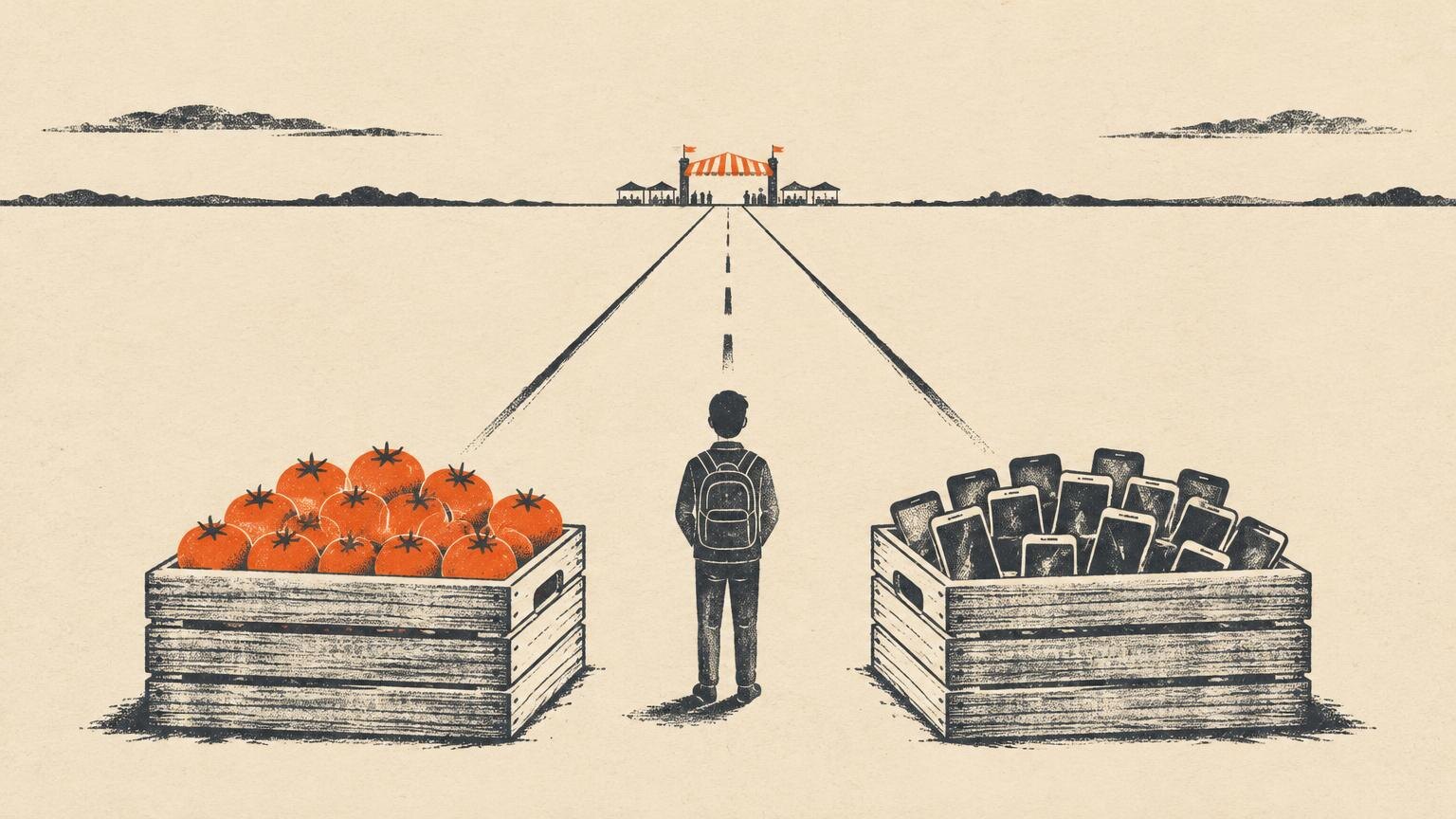
AI has made building digital products easier than ever.
Today, almost anyone can build a website or an application using a simple prompt. You don’t necessarily need to know how to code. You can describe what you want, and AI can help you build it.
Every day, we see new applications and websites appearing. Some solve real problems. Others make us wonder whether anyone actually needs them. I recently came across a website charging people to download a PDF. Apparently, even that can be a SaaS business.
Content creation is also becoming accessible to almost everyone. More people can create, publish and distribute content without needing a professional team.
But this raises an interesting question: what happens when everyone can build something?
Building something is becoming less of a competitive advantage. Understanding customers, identifying real demand, positioning a product and reaching the people who need it may become much more important.
Having a product available doesn’t mean people will find it, understand it or use it.
And this is not only a challenge for startups. Even large corporations struggle with customer discovery, adoption and getting people to consistently use the products they launch.
We are producing more products, but people’s time, attention and money have not grown at the same rate. Customers already have habits, trusted services and applications they use every day. Convincing them to try something new is not as easy as building it.
Everyone can produce. But can everyone sell?
Think about agriculture.
A farmer can produce excellent tomatoes, but that doesn’t automatically mean they will make money. They still need buyers, transportation, access to markets, storage and a good selling price.
Producing more tomatoes doesn’t necessarily solve these problems. Sometimes the biggest challenge is getting what you have produced to the right people, at the right time and at a price that makes the business viable.
I can relate to this from personal experience.
15 years ago, I was involved in a small chicken and egg business. We started with 150 chickens and eventually increased to 300. At full production, we were getting around 300 eggs every day.
Producing the eggs wasn’t the biggest challenge. Selling them was.
I would go to the market, knock on the doors of women who baked cakes or prepared food for sale, and even sit along the avenue trying to sell our eggs. Every day, we had around 300 eggs to sell, and we had to find enough customers for them.
We also tried to partner with restaurants, but that didn’t work out. They wanted to buy at 7 MT per egg, while our selling price was 10 MT. At that price, the numbers simply didn’t make sense for us.
Eventually, we had more eggs than we could sell. The business struggled and eventually went down.
Looking back, I realise that our problem wasn’t simply production. We had a distribution problem. We didn’t have enough customers, our access to larger buyers was limited, and competition was tough.
We had managed to increase production, but we hadn’t built the customer base and distribution channels needed to support it.
Being able to produce more doesn’t mean the market is ready to buy more.
And I think the same lesson applies to digital products.
The same challenge exists in technology
Imagine an entrepreneur in Maputo who builds an application to help small businesses manage their daily sales.
The application works. The design is good. It solves a real problem.
But reaching customers is another story.
Let’s imagine the entrepreneur reaches 1,000 potential customers. Around 400 visit the product, 150 register or install it, 60 actually use it, and only 25 remain active after 30 days.
These are illustrative numbers, but they show something important: building the product is only one part of the journey.
The entrepreneur still needs to reach business owners, explain the value, earn their trust, help them get started and give them a reason to keep using the application.
The farmer and the digital entrepreneur are producing completely different things, but they face a similar commercial challenge.
One needs buyers for the eggs or tomatoes. The other needs customers for the application.
Neither production nor availability guarantees a successful business.
Distribution is more than marketing
When we talk about getting customers for digital products, the conversation often goes straight to Facebook ads, influencers, paid traffic, social media content and SEO.
These are useful, but distribution is much bigger than marketing.
Marketing can help people discover a product. Distribution is also about making the product accessible, available, trusted and usable by the people who need it.
For example, an entrepreneur building a financial application might consider partnering with a bank, a telecom operator, a retailer or an established business association. These organisations already have relationships with customers and audiences that would otherwise take years to reach.
Of course, we all know how difficult it can be to establish partnerships with these organisations. Sometimes it almost seems impossible. Having a partnership strategy on paper and actually making it happen are two very different things.
But this doesn’t make distribution less important. It makes it something that needs to be considered much earlier.
Imagine if, before increasing production in our egg business, we had already secured reliable buyers who could take a significant portion of our daily production.
That could have changed the business.
The same applies to digital products. Understanding the market, validating demand and establishing potential distribution channels before investing heavily in development can make a significant difference.
The Mozambique reality
This challenge becomes even more interesting when we look at Mozambique.
Our country has approximately 5.2 million agricultural holdings, most of them small and medium-sized. Only around 39.9% of agricultural holdings have access to price information, while access to formal credit was below 1%.
These numbers remind us that producing something and successfully taking it to market are two different capabilities.
The same reality applies to digital products.
We have approximately 7.12 million internet users, representing around 19.8% of the population. This means that approximately 28.8 million people were still offline.
Even among those who are connected, we cannot assume that everyone is searching for new applications or willing to experiment with unfamiliar services.
People have different levels of digital literacy, different devices, limited data budgets and different preferences. For someone using a smartphone with limited storage, downloading another application is not necessarily a small decision.
Trust is another challenge. Someone may be comfortable using an established mobile money service or social media platform but hesitate to register with an unfamiliar application or share personal information.
This means that digital distribution cannot always be digital.
Sometimes, reaching customers requires visiting markets, universities, shops and communities. It means demonstrating how a product works, engaging merchants, helping people register and guiding them through their first transaction.
A digital product may still need physical distribution.
And this is something both entrepreneurs and large corporations need to consider when designing their go-to-market strategies.
We may need more people who understand markets
I don’t think our biggest problem today is that we don’t have enough people who can build applications.
AI is making that easier every day.
What we need are more people who understand markets. People who can identify existing behaviours, understand where customers already spend their money, recognise real problems and build products around those realities.
We also need better ways of connecting products to existing customer networks, even when establishing those partnerships is difficult.
And perhaps most importantly, we need to understand that acquiring a customer is not the same as retaining one.
Building an application in a few hours is impressive. Getting people to trust it, use it regularly and continue finding value in it is a much bigger challenge.
The mistake would be to assume that because technology has made production easier, building a successful business has also become easier.
It hasn’t. We are simply becoming better at producing things.
Whether we are talking about eggs in a small business, tomatoes in Manhiça or a mobile application in Maputo, some fundamentals remain the same:
find the customer, reach them, earn their trust and make the transaction happen. Because Building has become easier. Reaching people hasn’t.
Keep reading
21 November 2026
Are We Obsessed With Roadmaps?
At what point does managing the roadmap become more work than delivering the actual work?
Read article
15 November 2026
The Interface Is Changing. But Is Everyone Coming Along?
Why the future of digital products cannot be designed around the assumptions of the world’s most connected markets.
Read article
1 November 2026
When a Product Looks Successful but the Business Isn’t Winning
A product can look successful inside its own ecosystem while failing to deliver the reason the business invested in it.
Read article
Benjamim Paulino
End-to-end product strategist · Maputo, Mozambique