15 November 2026 · Translating…
The Interface Is Changing. But Is Everyone Coming Along?
Why the future of digital products cannot be designed around the assumptions of the world’s most connected markets.
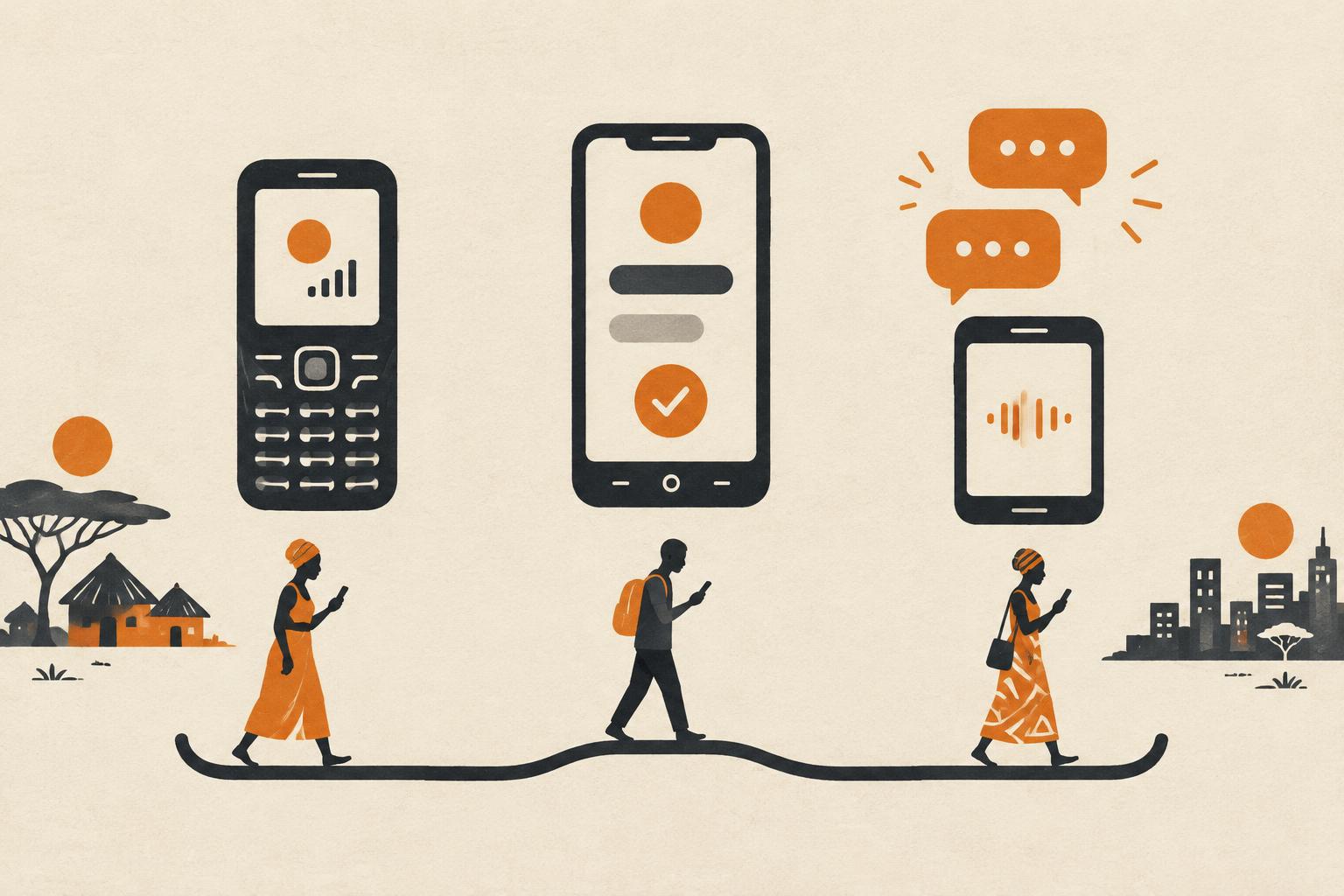
There is a lot of conversation about how AI is changing the way people interact with digital products.
We are moving from screens, menus and buttons towards conversational interfaces, voice assistants and AI agents that can understand what we want and execute tasks on our behalf.
The idea is exciting. Instead of opening an application, navigating through several screens and completing a process ourselves, we simply tell an AI agent what we want.
Fewer clicks. Fewer steps. Less effort.
But I think we need to question some of the assumptions behind this transition.
Is the interface really changing for everyone? And even when it changes, is the new experience necessarily better for everyone?
The global conversation is not necessarily the global reality.
In markets such as the US, Europe and parts of Asia, where smartphone adoption, connectivity, digital literacy and digital payment habits are relatively mature, moving towards AI-powered experiences might feel like a natural evolution.
But in many African markets, including Mozambique, the reality is different.
We still have customers navigating different levels of digital literacy, limited purchasing power, expensive data, entry-level smartphones, language barriers and varying levels of confidence when using digital services.
For some customers, simply completing a transaction through a mobile application is already a meaningful digital experience.
Introducing an AI agent does not automatically make that experience better.
In fact, it might introduce another layer of complexity.
We should also remember that customers don’t always want technology to do everything for them.
Think about making a payment.
When someone sends money through M-Pesa, they want to know what is happening. They select the recipient, enter the amount, review the details and confirm the transaction.
Then they wait for the confirmation message. The recipient also wants to receive that confirmation.
That final message matters. It gives both parties confidence that the transaction happened.
Could an AI agent make the process faster? Probably.
But speed is not the only thing customers value.
Sometimes, we want to participate. We want to make the selection, press the button, see the process happening and know that we completed the action ourselves.
Think about shopping, entertainment, gaming or even browsing for something new. The experience is not always just about reaching the final outcome. The process itself can be part of the enjoyment.
There is a difference between wanting technology to make something easier and wanting technology to do everything on our behalf.
I believe product teams need to understand that difference.
The objective should be to eliminate unnecessary friction, not meaningful participation.
This brings me back to something that should remain fundamental in digital product design: the three-step ambition.
Customers should be able to accomplish what they came to do with as few unnecessary steps as possible.
But reducing the number of steps should not mean removing important decisions, confirmations or moments of participation.
We need simplicity, but we also need control and confidence.
AI can help us achieve this without necessarily becoming the interface customers interact with.
It can work behind the scenes, understanding customer needs, recommending relevant products, simplifying navigation, explaining unfamiliar services and anticipating problems.
The customer does not necessarily need to interact with an AI agent to benefit from AI.
And perhaps this is where the conversation about inclusion becomes even more important.
We should not assume that the future of digital products will follow one universal path.
Some customers will prefer graphical interfaces. Others will prefer voice or messaging. Some will use AI agents. Others will continue relying on USSD.
The same customer might use different interfaces depending on the service, device, connectivity and situation.
The future will probably be a combination of these experiences rather than a complete replacement of one by another.
For African product leaders, this presents an interesting opportunity.
We shouldn’t simply copy the interfaces emerging from the world’s most connected markets. We should understand our customers, their realities and what makes them feel comfortable, confident and included.
This is not about building less sophisticated products for African customers. It is about building products that work for more people without limiting what they can experience.
The future of digital products should not be measured only by how much technology can do for people, but also by how many people can meaningfully participate in what technology makes possible.
The interface is changing. But making sure everyone comes along should be part of the product strategy.
Keep reading

21 November 2026
Are We Obsessed With Roadmaps?
At what point does managing the roadmap become more work than delivering the actual work?
Read article
8 November 2026
Everyone Can Grow Tomatoes. Everyone Can Build Apps. Who Can Sell Them?
Why distribution, not production, may become the biggest competitive advantage in the age of AI.
Read article
1 November 2026
When a Product Looks Successful but the Business Isn’t Winning
A product can look successful inside its own ecosystem while failing to deliver the reason the business invested in it.
Read article
Benjamim Paulino
End-to-end product strategist · Maputo, Mozambique